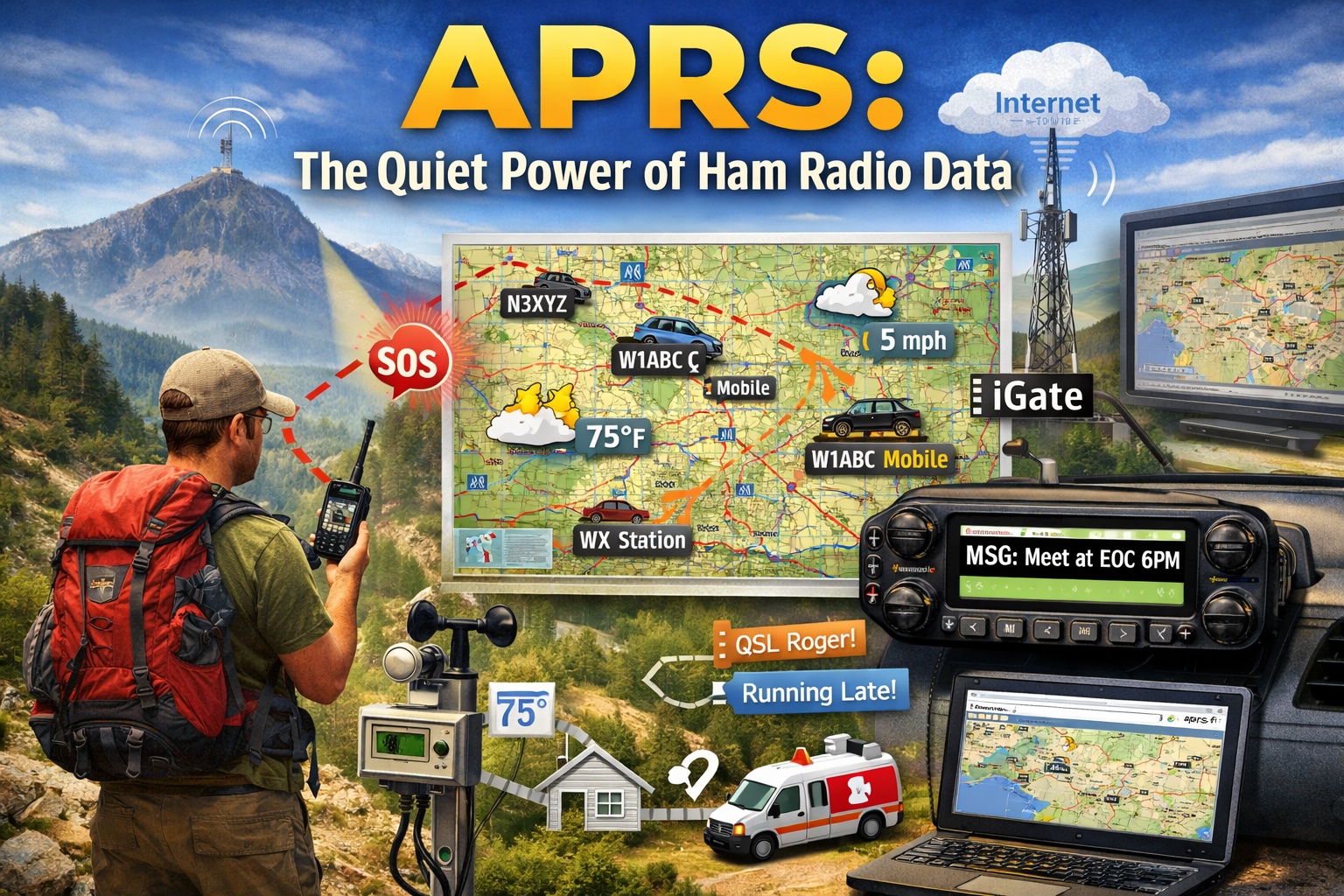
APRS for New Hams… Tracking, Messaging, and Real-World Use
APRS stands for Automatic Packet Reporting System. It lets you send short bursts of digital data over amateur radio. You share where you are, send short messages, and broadcast basic status info. It works on VHF and UHF and also connects to the internet through volunteer gateways.
Think of APRS as situational awareness for hams.
What APRS Does Well
APRS is simple by design. It focuses on quick data, not long conversations.
You can use APRS for:
-
Location tracking in real time
-
Beaconing your position while mobile
-
Sending short text messages
-
Sharing status like en route, at home, or emergency
-
Weather reporting from home stations
-
Tracking assets like radios, vehicles, or gear
Most APRS activity in the U.S. happens on 144.390 MHz.
Location Tracking
Location tracking is the most common APRS use.
Your radio or tracker sends a short packet with:
-
Latitude and longitude
-
Callsign
-
Speed and direction if moving
-
Optional status text
Other hams see you on their radios or on APRS maps like aprs.fi.
Common examples:
-
Driving to a hamfest and letting friends see your route
-
Monitoring a club event with multiple operators
-
Tracking emergency vehicles during drills or storms
Hiking and Lost Beacon Safety
APRS shines outdoors.
You can carry a handheld radio or small tracker that beacons your position every few minutes. If you hike, bike, or operate portable, APRS gives others a breadcrumb trail.
This helps when:
-
You miss a check-in time
-
You lose cell coverage
-
You need help but cannot talk clearly
Even without voice contact, your last known position may still get out through a digipeater or iGate.
Many operators set slower beacon rates like every 5 to 10 minutes to save battery.
APRS Messaging
APRS supports short text messages, usually up to about 67 characters.
You can:
-
Send a message to another callsign
-
Receive acknowledgments
-
Message from radio to radio
-
Message from radio to internet users
This works well when voice is busy or noisy.
Examples:
-
I am on scene
-
Running late
-
Meet at the north lot
-
Power is out here
Messages are not instant like texting. They depend on radio coverage and retries.
Status and Tactical Use
APRS lets you send status updates that stay visible.
Examples:
-
At station
-
Portable operation
-
Emergency power
-
Monitoring net
During events or incidents, operators often use tactical callsigns like EOC or Command. APRS helps net control see who is active and where they are without asking.
Weather and Telemetry
Some stations connect weather sensors to APRS.
They can report:
-
Temperature
-
Wind speed and direction
-
Rainfall
-
Barometric pressure
Others use APRS telemetry for:
-
Battery voltage
-
Generator status
-
Site health
This data updates automatically and helps with planning and response.
What You Need to Get Started
You do not need much.
Basic options:
-
A handheld or mobile radio with built-in APRS
-
A GPS-enabled radio
-
A TNC or soundcard interface
-
A simple external GPS if required
Many modern radios include APRS out of the box. You can also run APRS on a computer or Raspberry Pi as a fixed station.
Why APRS Is Worth Learning
APRS teaches good operating habits.
-
Short transmissions
-
Clear identification
-
Efficient use of spectrum
It adds real value even when you are not talking.
If you travel, hike, volunteer, or support public service events, APRS becomes useful fast. You set it up once, then it quietly works in the background.
For new hams, APRS is one of the easiest ways to see how radio, data, and community all connect.
editor's pick
latest video

news via inbox
Nulla turp dis cursus. Integer liberos euismod pretium faucibua