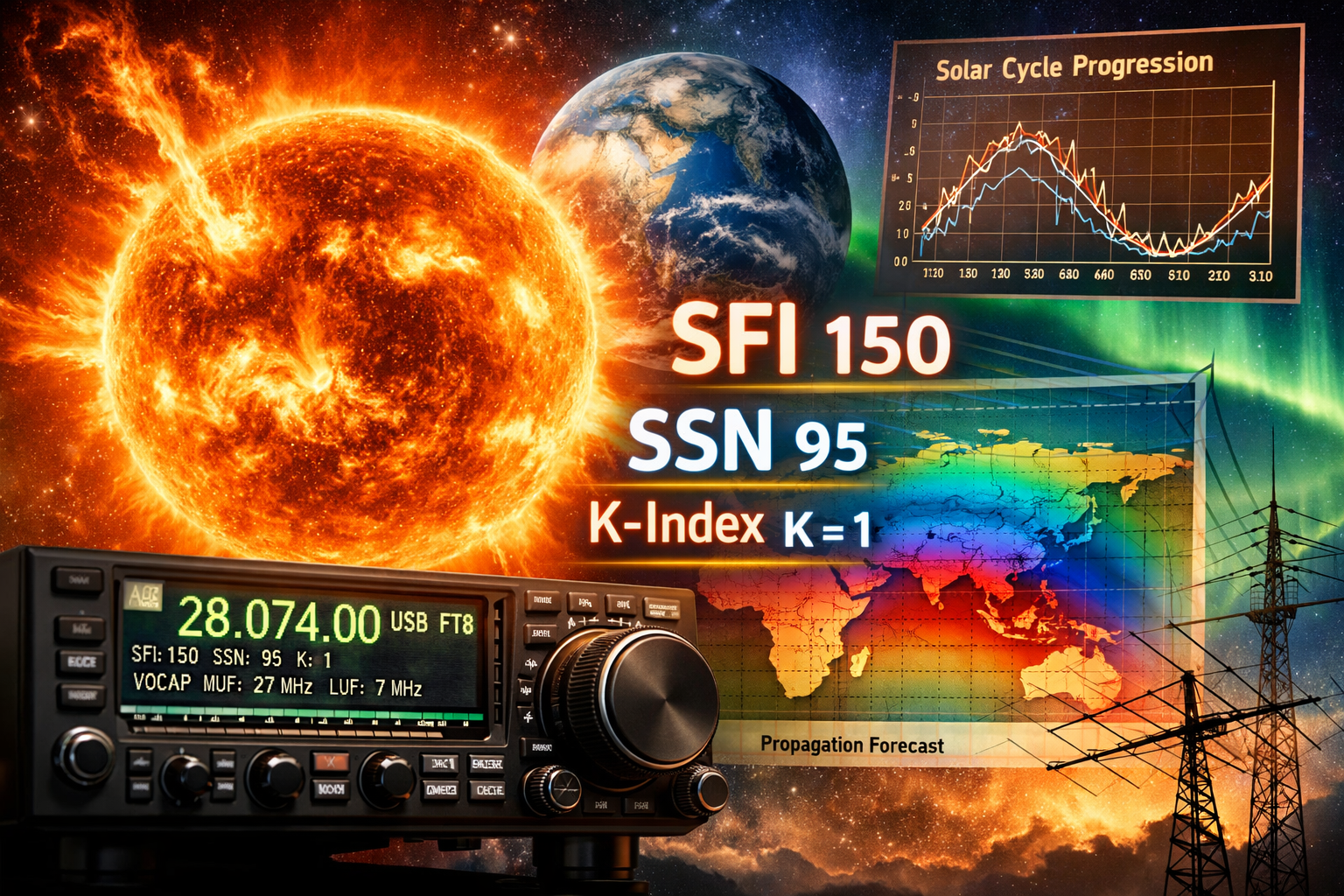
Read the Sun, Work the World…Solar Indices Made Simple for HF Operators
Every day the Sun shapes what you hear on HF. Solar indices give you a quick way to judge band conditions before you ever spin the dial. The Solar Flux Index, or SFI, tells you how much solar energy is charging the ionosphere. Higher numbers usually mean higher Maximum Usable Frequency, which means better chances on 15 and 10 meters. The Sunspot Number tracks the overall strength of the solar cycle and helps you see longer term trends. The K index measures geomagnetic disturbance. It updates every three hours and tells you how stable the ionosphere is right now. Low K values mean steadier signals and stronger DX paths.
When you look at these numbers together, they become practical tools. SFI above 130 and SSN above 80 suggest strong high band potential. A K index of 2 or lower means those bands are likely to be stable. If K jumps to 5 or higher, expect fading, noise, and polar path issues even if SFI is high. By checking these values each morning, you can decide whether to focus on 20 meters for reliability, push up to 15 or 10 for DX, or wait for quieter geomagnetic conditions. Over time, you will start to connect the numbers with what you hear on your own station, and that is when propagation prediction becomes second nature.
Ham Radio Solar Indices Cheatsheet
1. Solar Flux Index (SFI)
- Measures solar energy at 10.7 cm (2800 MHz).
- Higher SFI raises the Maximum Usable Frequency (MUF).
- 60–80: Low activity. 10m closed. 20m dependable.
- 90–120: Moderate. 15m improves. 10m may open midday.
- 130–180: Strong. 10m and 12m open regularly.
- 200+: Excellent high-band conditions when K is low.
2. K-Index
- Measures geomagnetic disturbance. Updates every 3 hours.
- Scale 0–9. Lower is better for HF stability.
- 0–1: Quiet. Excellent DX conditions.
- 2–3: Minor impact. Most bands stable.
- 4–5: Storm levels. High bands degrade first.
- 6–9: Major storm. HF unstable. Polar paths collapse.
3. Sunspot Number (SSN)
- Counts visible sunspots and groups.
- Tracks long-term solar cycle strength.
- 0–20: Solar minimum. 10m mostly closed.
- 30–70: Improving. 15m stronger.
- 80–150: Strong cycle. 10m opens often.
- 150+: High activity. Excellent high-band potential when K is low.HF Propagation Tools and Limits
4. MUF – Maximum Usable Frequency
- Highest frequency that will refract back to Earth over a given path.
- If you operate above MUF, the signal passes into space.
- Higher SFI and SSN raise MUF.
- Example: MUF 28 MHz means 10m may support that path.
- MUF varies by distance, time of day, and solar conditions.
5. LUF – Lowest Usable Frequency
- Lowest frequency that can overcome absorption and noise.
- Below LUF, signals are absorbed in the D-layer.
- LUF rises during daylight and geomagnetic storms.
- Example: LUF 5 MHz means 80m may be weak or unusable.
- Nighttime lowers LUF, improving 40m and 80m.
6. VOACAP
- Voice of America Coverage Analysis Program.
- Propagation prediction model using SFI, SSN, K, location, and time.
- Estimates probability of successful communication between two points.
- Shows MUF, best band, takeoff angle, and reliability percentage.
- Useful for planning DX, portable ops, and contest strategy.
Best HF Scenario for High Bands (10m, 12m, 15m):
- SFI above 130
- SSN above 80
- K-Index 2 or lower
- MUF above 21–28 MHz for your path• LUF below your operating band
editor's pick
latest video

news via inbox
Nulla turp dis cursus. Integer liberos euismod pretium faucibua